 FiberQ
FiberQ
FiberQ
Choosing the best China CWDM transceiver is not simply a matter of comparing prices or advertised distance. A reliable choice begins with the network’s actual link budget, wavelength plan, fiber type, and operating environment. In a data center, a 20-kilometer module may connect two racks comfortably. In a rural cabinet, heat, dust, and unstable power may matter more than headline speed.
Jim Hayes, a veteran fiber-optics educator, offers a practical principle: “Start with the link budget, not the product label.” That advice fits CWDM transceiver selection closely. Buyers should examine insertion loss, receiver sensitivity, wavelength accuracy, DOM support, temperature ratings, and interoperability with existing switches. They should also request test records, calibration details, and clear warranty terms from the supplier.
China has many capable optical manufacturers. Quality, however, is not identical across every factory. Some vendors provide strong engineering support and consistent batch testing. Others depend heavily on standard designs with limited customization. The cheapest module can become expensive after repeated link faults, emergency replacement, or difficult troubleshooting.
A careful evaluation should include sample testing. Measure optical power. Confirm wavelength performance. Test the module with the target switch. Check behavior after several hours in a warm enclosure. Datasheets rarely show every field reality.
There is no universal winner. The best China CWDM transceiver is the one that meets verified technical requirements, remains stable in its installation, and receives dependable support after purchase. That conclusion may sound less exciting, but it is more honest.
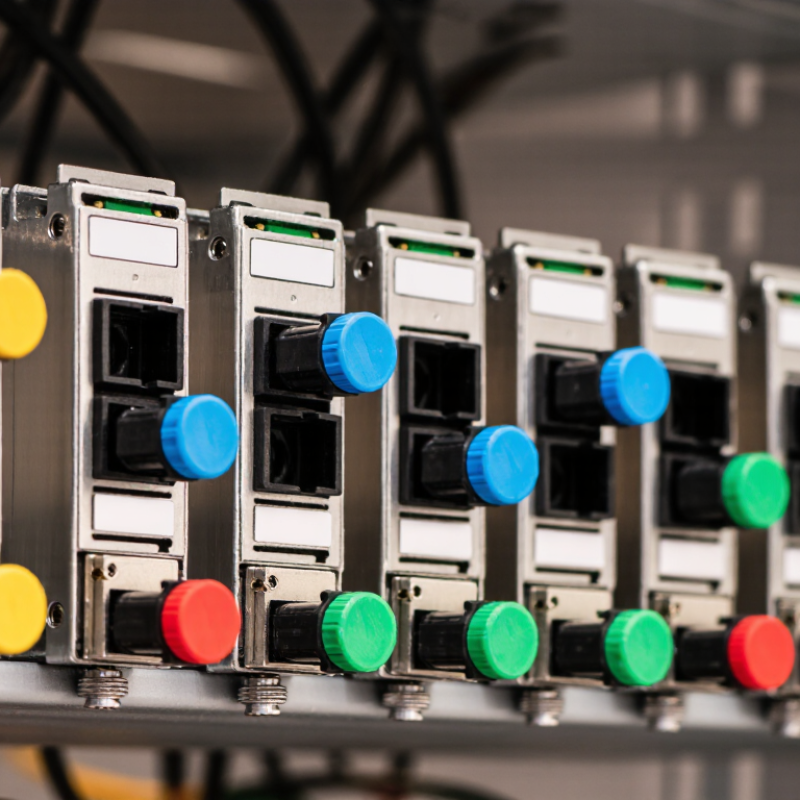
A China CWDM transceiver is an optical module manufactured in China for wavelength division multiplexing networks. It sends and receives data through specific light wavelengths. CWDM combines several channels over one fiber. Each channel uses a different wavelength, such as 1310 nm, 1490 nm, or 1550 nm. This design can expand network capacity without installing additional fiber cables.
The module usually connects switches, routers, or transport equipment. It may use duplex single-mode fiber for regional links. Before purchasing, I check the data rate, transmission distance, connector type, and optical budget. A clear datasheet matters. Temperature ratings also deserve attention. Digital monitoring helps track temperature, voltage, and optical power during operation. I also verify compatibility with the host device and network standards. Do not assume every module has identical performance.
“China” describes the manufacturing origin, not one fixed quality level. Manufacturing quality can vary between suppliers and production batches. Some modules perform steadily for years. Others show unstable readings under heat or heavy traffic. That difference matters. During installation, a clean connector and correct polarity prevent many failures. A small amount of dust can weaken the optical signal. I have seen link problems blamed on the transceiver when the real cause was poor fiber cleaning. This is not a minor detail. For reliable selection, request test records, coding information, and warranty terms. Ask for samples when possible. Then compare measured results with the published specifications.
| Transceiver Type | Typical Data Rate | Common CWDM Wavelengths | Typical Reach | Fiber Type | Connector | Duplex Configuration | Typical Operating Temperature | Best-Fit Application | Selection Assessment |
|---|---|---|---|---|---|---|---|---|---|
| 1G CWDM SFP | 1.25 Gb/s Ethernet or equivalent optical service | 1270–1610 nm, depending on the assigned channel | Up to approximately 80 km, subject to optical budget and fiber conditions | Single-mode fiber | Duplex LC | Duplex fiber pair | Commercial: 0–70°C Extended: −40–85°C |
Campus links, access networks, industrial Ethernet, and lower-capacity metro connections | Best for cost-sensitive 1G links |
| 10G CWDM SFP+ | 10 Gb/s Ethernet or compatible optical service | 1270–1610 nm, normally spaced on a 20 nm CWDM grid | Up to approximately 70–80 km, depending on transmitter output, receiver sensitivity, and passive loss | Single-mode fiber | Duplex LC | Duplex fiber pair | Commercial: 0–70°C Extended: −40–85°C |
Data-center interconnects, metro networks, enterprise backbones, and carrier access networks | Best overall for 10G CWDM |
| 25G CWDM SFP28 | 25.78 Gb/s Ethernet, commonly used with 25G optical interfaces | Selected CWDM channels within the 1270–1570 nm range, depending on the optical design | Commonly 10–40 km; longer distances require a carefully matched optical budget | Single-mode fiber | Duplex LC | Duplex fiber pair | Commercial: 0–70°C Extended options may be available |
High-density server uplinks, modern enterprise aggregation, and short-to-medium metro links | Best for higher-density 25G networks |
| 40G CWDM QSFP+ | 40 Gb/s Ethernet | Four optical lanes using separate wavelengths, commonly around the 1270–1330 nm region | Typically up to 10 km over single-mode fiber | Single-mode fiber | Duplex LC or MPO/MTP, depending on the optical architecture | Parallel or multiplexed optical lanes | Commercial: 0–70°C | Data-center interconnection and aggregation where 40G switching is required | Best for legacy 40G deployments |
| 100G CWDM4 QSFP28 | 100 Gb/s Ethernet | Four LAN-WDM/CWDM-style lanes near the 1310 nm region | Commonly up to 2 km over duplex single-mode fiber | Single-mode fiber | Duplex LC | Four wavelengths multiplexed over two fibers | Commercial: 0–70°C | Short-reach data-center interconnects and high-capacity leaf-spine networks | Best for short-reach 100G |
| 100G PSM4 QSFP28 | 100 Gb/s Ethernet | Four parallel optical lanes around the 1310 nm band | Typically up to 2 km over four single-mode fiber pairs | Single-mode fiber | MPO/MTP | Parallel-fiber transmission | Commercial: 0–70°C | Short-reach data-center links where parallel fiber cabling is available | Best for parallel-fiber infrastructure |
| BiDi CWDM SFP/SFP+ | 1G or 10G, depending on the module class | Paired transmit and receive wavelengths, such as 1270/1330 nm or 1330/1270 nm | Commonly 10–40 km; some versions support longer distances | Single-mode fiber | Simplex LC | Single-fiber bidirectional transmission | Commercial: 0–70°C Extended options may be available |
Network expansion where only one spare fiber is available | Best for saving fiber capacity |
| Industrial CWDM SFP/SFP+ | 1G or 10G, depending on the interface | One assigned CWDM channel from the supported wavelength grid | Typically 10–80 km, based on the data rate and optical budget | Single-mode fiber | Duplex LC | Duplex fiber pair | Industrial: −40–85°C | Transportation, utilities, outdoor cabinets, surveillance, and factory automation | Best for harsh environments |
| Unmanaged CWDM Transceiver | Varies by host interface and optical standard | Fixed wavelength selected during specification | Determined by optical power budget, fiber attenuation, and passive component loss | Usually single-mode fiber | LC, SC, or MPO/MTP, depending on the design | Duplex or simplex | Commercial or industrial, depending on the model | Simple point-to-point links where advanced diagnostics are not required | Best for simple deployments |
| DDM/DOM-Enabled CWDM Transceiver | Available across 1G, 10G, 25G, and other supported interface classes | Fixed CWDM wavelength with digital monitoring support | Based on the selected optical budget and system design | Single-mode fiber | Usually duplex LC or simplex LC for BiDi | Duplex or simplex | Commercial or industrial, depending on the model | Networks requiring monitoring of temperature, voltage, bias current, transmit power, and receive power | Best for proactive maintenance |
Note: Actual reach depends on the transceiver’s optical budget, fiber attenuation, connector and splice losses, passive CWDM multiplexer/demultiplexer loss, chromatic dispersion, and operating temperature. Compatibility should be verified against the host equipment, supported wavelength plan, Ethernet standard, coding requirements, and diagnostic functions before deployment.
The host converts electrical data into optical pulses. A laser assigns each stream a wavelength. A passive multiplexer combines these wavelengths on one fiber. At the far end, a demultiplexer separates them. A photodiode converts the signals back into electrical data.
CWDM commonly uses 20-nanometer channel spacing. Typical channels range from 1271 to 1611 nanometers. Confirm the exact wavelength before ordering. Small mismatches can prevent proper communication.
Calculate the optical budget, rather than trusting the distance label. Check transmit power, receiver sensitivity, fiber length, and connector loss. Splices, bends, and dirty connectors reduce available margin. A 40-kilometer rating may fail on a damaged route. Distance claims need context.
Check wavelength accuracy, extinction ratio, bit-error rate, and thermal behavior. Verify the form factor, duplex connector, fiber type, and operating temperature. Digital diagnostics should show temperature, voltage, bias current, and optical power. Some datasheets omit important values. That deserves caution.
Not necessarily. Confirm the wavelength plan, data rate, connector, fiber type, and host-device coding. Also check the management interface. Two modules can share a speed but still fail together. Test the actual link.
Monitoring can reveal rising temperature, weak receive power, unstable bias current, or abnormal voltage. These readings help identify problems before the link completely fails. Record baseline values during installation. Compare later readings against them. Numbers help.
They can carry Ethernet traffic across existing single-mode fiber in metropolitan networks. They may connect buildings, storage systems, or security equipment. Industrial sites need stronger temperature tolerance near electrical machinery. Crowded cabinets require careful airflow checks. Heat exposes weaknesses.
Test several samples under real traffic and expected temperatures. Request factory records linked to serial numbers. Inspect alarms and compare bit-error-rate results. Clean connectors and cabinet air intakes before judging the optics. I once blamed the module too quickly. Dust was the real problem.
A China CWDM transceiver is an optical networking device designed to transmit and receive multiple data channels over a single fiber pair by using different wavelength bands. It combines wavelength division multiplexing with standard optical interfaces, allowing network operators to expand capacity without installing additional fiber. Its operation depends on optical modules, wavelength filters, transmitters, receivers, and monitoring functions that separate and combine signals accurately.
When comparing CWDM transceivers, important specifications include transmission distance, supported data rates, wavelength range, fiber type, connector design, operating temperature, power consumption, and compatibility with existing equipment. The best China CWDM transceiver should match the network’s technical requirements, installation environment, and future expansion plans. It should also provide stable performance, reliable optical power, consistent manufacturing quality, and clear testing documentation. These devices are suitable for data centers, metropolitan networks, telecommunications links, enterprise backbones, and other applications requiring flexible capacity and dependable long-distance connectivity.
